Kimodo: Notes From a Constrained-Motion Review
This is an AI-assisted exploratory research note. It combines primary-source review with a small local probe; the local media below documents an observation and a rejected-quality boundary, not validated model performance.
The question was narrow: where does Kimodo sit in a motion workflow, and what should be expected from it? The answer is more useful when separated into method, data, observations, and limits.
Research method
Four evidence streams were used.
| Evidence | What was checked | What it can support |
|---|---|---|
| NVIDIA paper and project documentation | Model scope, inputs, outputs, training data, and stated limitations | Claims about the released model |
| Released code and format documentation | CLI inputs, constraints, conversion formats, frame rate, and exports | Claims about the public implementation |
| Local probe | One short, fixed-seed constrained generation | That this installation could produce a skeleton clip |
| Independent review pass | Source comparison and challenge of the preliminary conclusion | A check against unsupported inference |
No result was treated as evidence merely because an animation could be rendered. The local probe did not include a reference motion-capture ground truth, a final character retarget, or a contact-validation pass. Those cases are outside the scope of this note.
Data and models examined
Kimodo is trained on optical motion-capture data. NVIDIA reports that the full Rigplay training set contains about 700 hours of motion from 170 performers, while the public BONES-SEED subset is used for reproducible evaluation. The documented behavior range includes locomotion, gestures, everyday activity, object interaction, combat, dance, and motion styles. Kimodo technical report Kimodo benchmark introduction
The local study used Kimodo-SOMA-RP-v1.1. Its target duration was 4.14 seconds; the exported clip is 124 frames at 30 Hz (4.133333 seconds). It used 30 denoising steps, fixed seed 42, one dense 124-frame root-2D path, and post-processing disabled. This is a reproducibility record, not a quality score or a claim that the clip represents the model’s general performance.
Research transparency
| Role | Model or setting |
|---|---|
| Motion model under review | Kimodo-SOMA-RP-v1.1 |
| Local inference profile | Target 4.14 s; output 124 frames / 4.133333 s at 30 Hz; 30 denoising steps; seed 42; one dense root-2D path; post-processing off |
| Research assistance | Codex based on the GPT-5 family |
| Independent source review | gpt-5.6-sol |
| Reasoning-effort label | Not exposed by the runtime; no numeric level is claimed |
The AI systems were used to locate primary sources, compare the documentation with the code, and challenge the interpretation. The linked NVIDIA sources, rather than an assistant score, are the basis for the findings below.
Local diagnostic probe
Self-produced side-view diagnostic render. It is a Kimodo skeleton output, not a source video, retarget, or finished character animation.
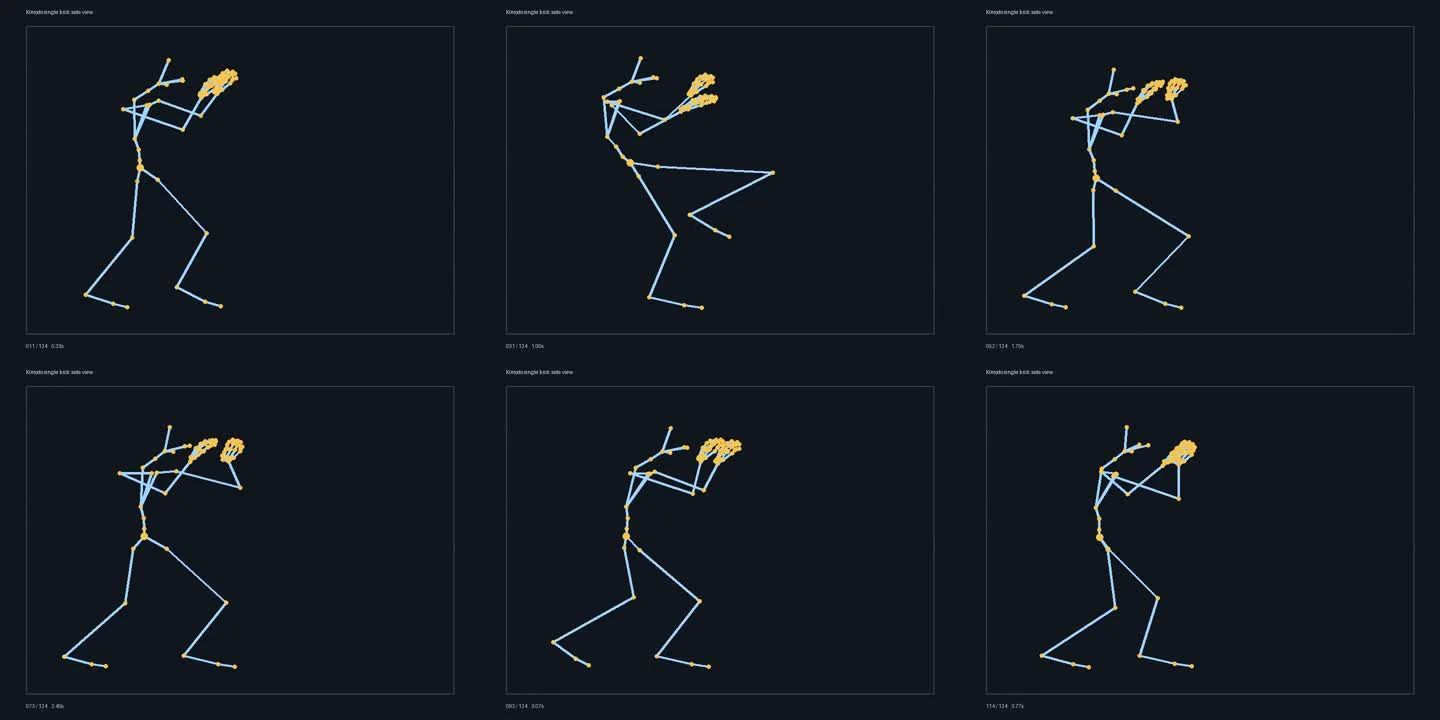
Six sampled frames from the same 124-frame clip. The orange clusters are distal hand and finger joints drawn point-by-point by the diagnostic renderer, not a tail or extra limbs.
| Setting | Recorded value |
|---|---|
| Motion model | Kimodo-SOMA-RP-v1.1 |
| Prompt | “A soccer player takes two approach steps then plants the left foot and swings the right leg forward to kick an imaginary ball once before following through and returning to balance without jumping.” |
| Samples / seed / denoising | 1 / 42 / 30 steps |
| Duration | Target 4.14 s; output 124 frames at 30 Hz (4.133333 s) |
| Kinematic input | One dense root2d path, frames 0–123; 124 points; x = −0.379334 to 0.025849 m; z = 0 |
| Export and post-processing | BVH export; --no-postprocess |
The root path was converted from pre-extracted landmarks; the source imagery is not published here. No foot targets, full-body keyframes, object state, inverse kinematics, contact check, or post-processing were used. The clip therefore shows that the installation emitted a skeleton sequence, but it does not establish a convincing approach, a verified strike, foot contact, ball interaction, or general motion quality.
What the evidence supports
Kimodo is an offline model for authoring short 3D skeleton motions from text and kinematic controls. Its documented controls include sparse full-body keyframes, hand and foot end-effectors, 2D root waypoints, and dense 2D root paths. Kimodo project page Constraint documentation
| Research question | Evidence-led finding |
|---|---|
| What is the model’s input? | A text prompt with optional kinematic constraints, not raw footage |
| What is the output? | A 3D skeleton motion with joint positions and rotations, root motion, and foot-contact labels |
| What data can be imported? | Compatible SOMA BVH, AMASS/SMPL-X NPZ, or G1 CSV; arbitrary BVH files are not guaranteed to work |
| What temporal rate does it use? | The Kimodo conversion path standardizes accepted motion to 30 Hz |
| How should control be applied? | Primarily through sparse constraints, except for a dense root path |
The output and conversion documentation make the boundary clear: structured motion can be converted into Kimodo’s representation, but a video file is not a documented input. NVIDIA separately identifies GEM as a model for human-motion reconstruction from video. Motion conversion documentation GEM project page
Observed advantages
| Advantage | Why it matters | Evidence boundary |
|---|---|---|
| Several complementary controls | A route, a sparse pose, and foot or hand targets can be combined | Valid only for supported constraint types |
| Short-clip authoring | A model can fill transitions around a few trusted anchors | It is not frame-exact reconstruction |
| Reproducible artifacts | Prompts, seeds, constraints, NPZ files, and BVH exports can be retained | Reproducibility does not establish quality |
| Production-oriented motion data | Training is based on optical mocap rather than video-only reconstruction | Coverage of a particular action still needs its own test |
The model’s design favors a practical animation-authoring loop: establish a small number of anchors, generate candidates, choose one, and revise the constraints. The official interactive demo is built around that loop. Interactive demo documentation
Known problems and limits
| Limit | Practical consequence |
|---|---|
| No raw-video input | Video motion must first be reconstructed by a separate system |
| Sparse controls are preferred | Dense frame-by-frame pose tracks are not the intended control method |
| Prompt length is limited | Each prompt is limited to 10 seconds; complex sequences need separate, self-contained segments |
| Constraints can be missed | Raw output may foot-skate or fail to land precisely on a target |
| No object state in the output | Object contact and dynamics require separate data and validation |
NVIDIA recommends fewer than 20 constrained frames per constraint type, excluding a dense root path, and recommends post-processing when constraint accuracy and foot contact are important. The same documentation notes that post-processing improves raw output but does not make it a substitute for validation. Kimodo best practices
The official benchmark follows the same separation. It evaluates motion quality, constraint following, and text alignment as different axes, rather than turning one visually plausible sample into a general model score. Kimodo metrics documentation
Reference conclusion
The evidence supports Kimodo as a constrained, short-form skeleton-motion authoring model. Its strongest use is to propose or complete motion around a small set of reliable kinematic anchors.
The evidence does not support treating it as a video-to-skeleton system, an object-physics system, or a standalone final-quality guarantee. Those are separate stages with separate measurements.
This is a cautious conclusion from documentation review and one local probe. A broader decision would require target-domain motion data, independent retargeting checks, and repeatable evaluation beyond the limited study recorded here.