From Pixel Brief to Blender Reference: Four Image Models for 2D-to-3D Game Art
An image is not a 3D asset. For a 2.5D game, the practical question is narrower: can one generated view give an artist enough reliable information to model a clean, original prop in Blender?
This test uses one object from the Kickshatter: Pixel Cup visual language: a freestanding angular gold shield gate, split around a deep white goal frame, a short dark net cage, and a few cyan glass fragments. The output must be a single prop on a plain studio ground—no player, ball, stadium, label, turntable, contact sheet, or duplicated object. The selected image remains a geometry_reference; a reviewed .blend, independent render, and exported .glb are separate downstream gates.
The result
Z-Image Turbo was the strongest 2D-to-3D reference generator in this test. It was not the prettiest in every frame; it was the most useful because both seeds expose a coherent goal frame, net cage, side depth, and separated material regions. Qwen produced detailed material studies, but the large shield often obscured the goal. Anima drifted into abstract cages. FLUX produced useful individual cues but not a stable canonical blueprint.
| Model | Seed 42 | Peak VRAM | Geometry-reference decision |
|---|---|---|---|
| Qwen Image 2512 FP8 | 216.334 s | 24,028 MiB | Secondary material/construction reference |
| Z-Image Turbo BF16 | 20.273 s | 23,355 MiB | Best source-reference candidate |
| Anima Aesthetic v1.1 | 31.789 s | 6,587 MiB | Reject |
| FLUX.2 Klein 9B Q8 | 51.122 s | 21,083 MiB | Loose reference only |
All models used the same 1056 × 1584 portrait canvas and seeds 42 and 1337, but their native model graphs and prompt syntax remained different. No LoRA, IP-Adapter, ControlNet, or third-party VAE was loaded.
What a modelling reference must show
The score is not “does this look expensive?” It is whether the image reduces ambiguity for the person building the mesh.
| Criterion | Practical meaning |
|---|---|
| G1 — Part separation | Shield, goal frame, net, and fragments can be named as separate meshes/material slots |
| G2 — Construction evidence | The view exposes front, side, roof, and rear depth well enough to infer a simple low-poly build |
| G3 — Materials | Gold, matte white, net, and glass are visually distinct |
| G4 — Brief adherence | One freestanding shield-gate goal, not a stadium, character, or unrelated cage |
| G5 — Repeatability | The second seed is still the same kind of prop |
Native workflows and dedicated prompts
The model choices and graph topology follow the same native recipes used in the pixel-art benchmark: Qwen Image 2512 uses its official 50-step workflow and supported 2:3 bucket; Z-Image Turbo keeps its short distilled Turbo graph; Anima keeps its own ER-SDE graph; FLUX.2 keeps FluxGuidance with no negative prompt. Qwen native workflow Z-Image model table FLUX.2 prompting guidance
Qwen Image 2512 FP8
AuraFlow shift 3.1 · Euler/simple · 50 steps · CFG 4.0
One original 2.5D football-game obstacle shown as a single Blender modelling reference: a freestanding angular gold shield gate split open around a deep white goal frame, with a short visible net cage and a few translucent cyan glass fragments caught at the break. Three-quarter orthographic camera, centered on a plain dark-navy studio ground with a small soft contact shadow. Clear low-poly planar construction, separated PBR material regions for brushed gold, matte ice-white frame, dark navy net, and translucent cyan glass; readable front, side, roof, and rear depth in one coherent object. Use clean game-ready proportions, crisp silhouette, limited ink navy, gold, ice white, cyan, and restrained grass-green accent palette. Portrait composition, no typography, no interface, no turntable, no sheet.
Negative prompt: text, letter, number, logo, watermark, brand, football, player, stadium, UI, pedestal label, contact sheet, multi-view grid, duplicated prop, cut-off geometry, photoreal product photo, organic melted shapes, excessive particles.
Z-Image Turbo BF16
AuraFlow shift 3.0 · Euler/simple · 9 steps · CFG 1.0
A single original 2.5D football-game modelling reference: a freestanding angular gold shield gate split open around one deep ice-white goal frame with a short dark-navy net cage and a few translucent cyan glass fragments. Centered three-quarter orthographic view on a plain dark-navy studio ground, clean low-poly planar geometry, clear front side roof and rear depth, distinct brushed gold matte white dark net and cyan-glass materials, a small contact shadow, limited navy gold ice-white cyan palette, portrait composition, no text, UI, sheet, player, ball or stadium.
The Turbo prompt is one connected natural-language object description with an empty negative prompt. Z's own model table describes Turbo as an eight-step, CFG-free generation variant rather than an editing or long-step base model. Z-Image model table
Anima Aesthetic v1.1
AuraFlow shift 3.0 · ER-SDE/simple · 30 steps · CFG 4.0
masterpiece, original stylized 2.5D football game prop, freestanding angular gold shield gate split open around one deep ice-white goal frame, short dark navy net cage, translucent cyan glass fragments, three-quarter orthographic view, plain dark navy studio ground, low-poly planar construction, clean material separation, brushed gold, matte ice white, dark net, cyan glass, small contact shadow, centered portrait composition, crisp readable silhouette
Negative prompt: text, number, logo, watermark, brand, football, player, stadium, UI, pedestal label, contact sheet, multi-view, turntable, duplicate prop, cropped geometry, glossy photoreal product photo, organic shapes.
FLUX.2 Klein 9B Q8
FluxGuidance 3.5 · UniPC/simple · 12 steps · sampler CFG 1.0
One freestanding angular gold shield gate split open around a deep ice-white football goal frame with a short dark-navy net cage and translucent cyan glass fragments. A centered three-quarter orthographic 2.5D game-art modelling reference on a plain dark-navy studio ground, with clear low-poly planar depth, distinct brushed-gold, matte ice-white, dark-net, and cyan-glass material regions, a small contact shadow, and a crisp limited navy, gold, ice-white, and cyan palette.
FLUX.2 received no negative prompt, consistent with its documented positive-description workflow.
Evidence: seed 42
Qwen Image 2512 FP8

Qwen delivers the richest material differentiation, including readable net and glass. The outer shield is so dominant that it obscures the central goal construction, which limits it as a single canonical build reference.
Z-Image Turbo BF16
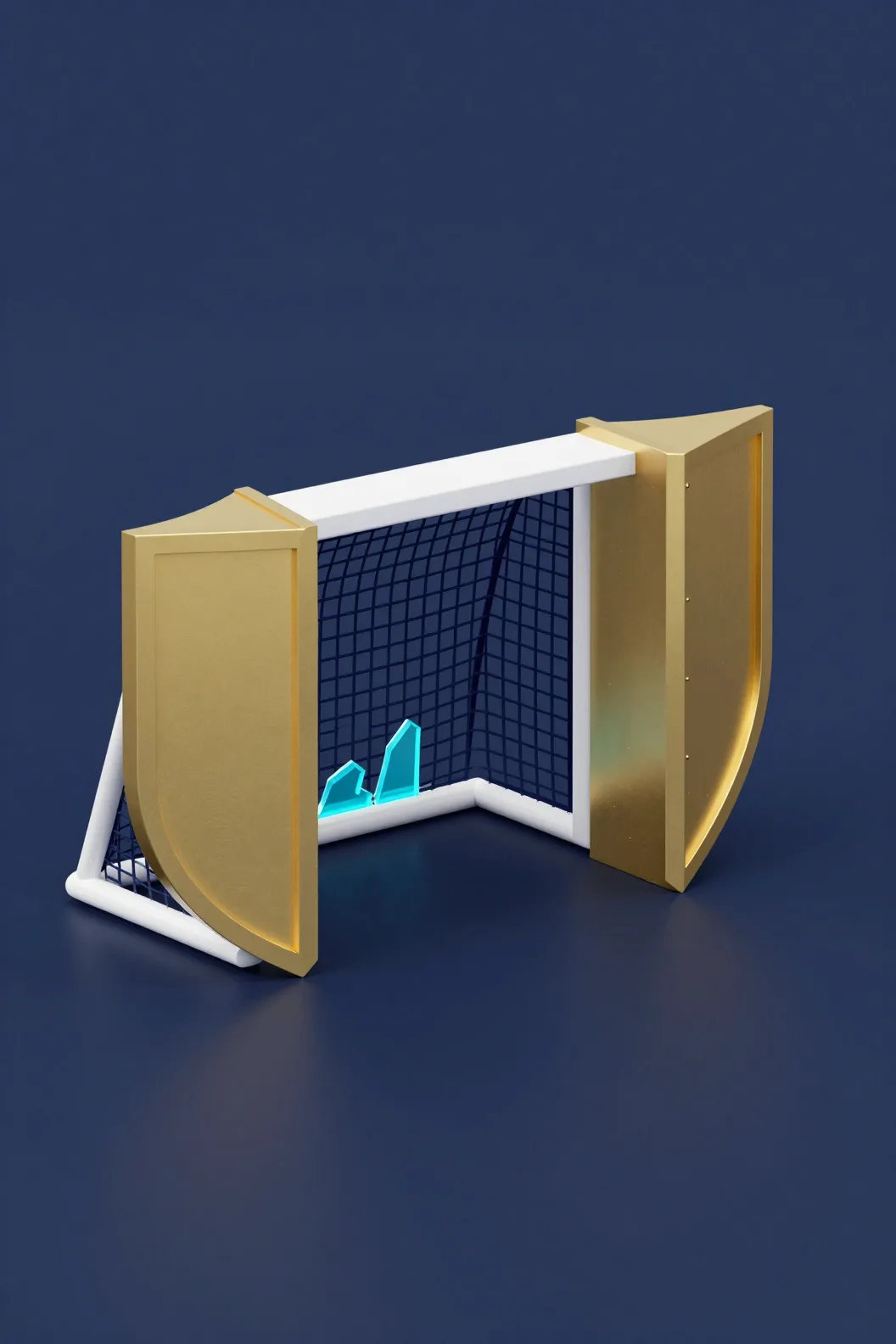
Z exposes the most useful whole-object evidence: frame depth, a rear net cage, a side plane, material boundaries, and a simple ground relationship. It does not perfectly follow the split-gate request, but it is the least ambiguous handoff to a low-poly modeller.
Anima Aesthetic v1.1
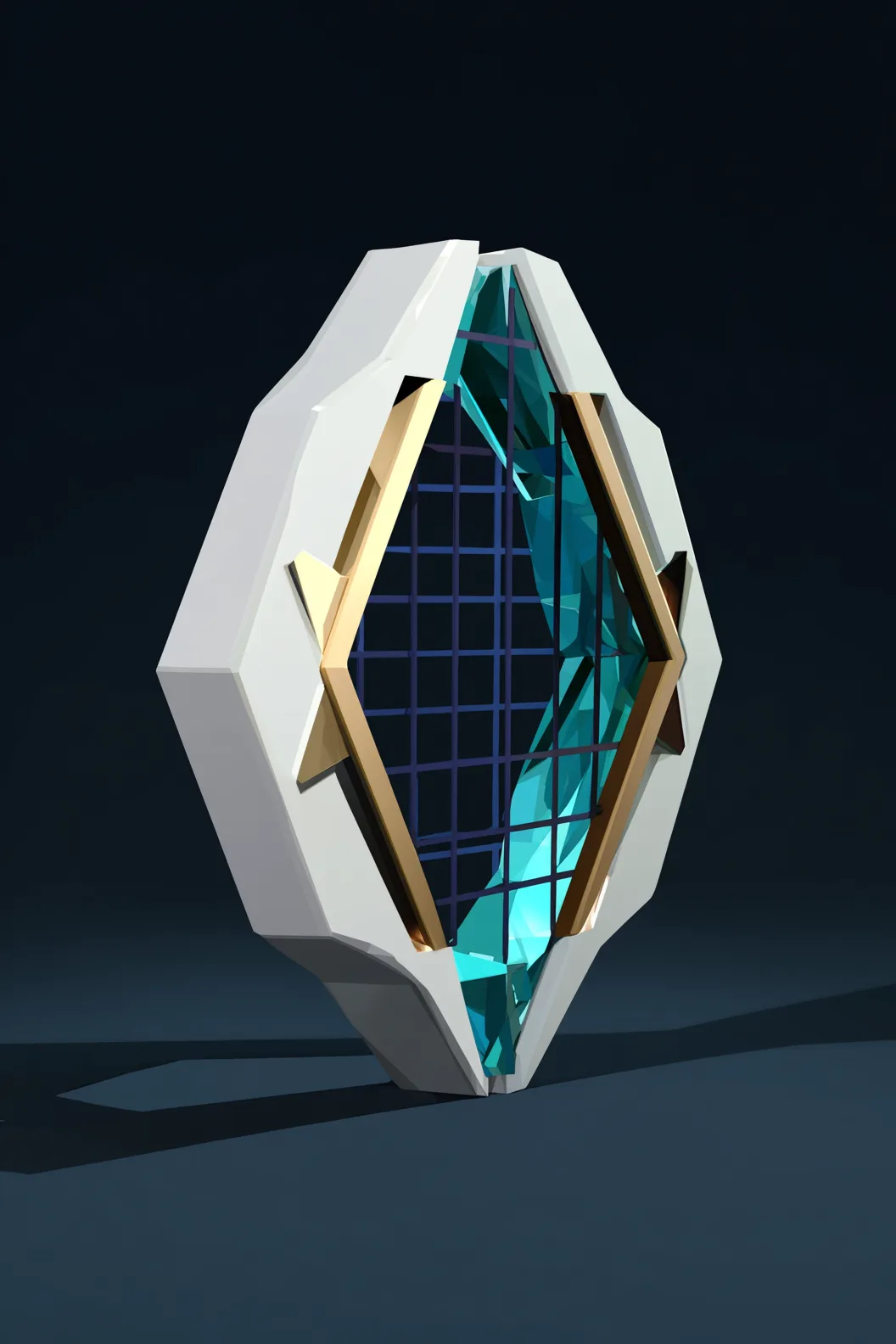
FLUX.2 Klein 9B Q8
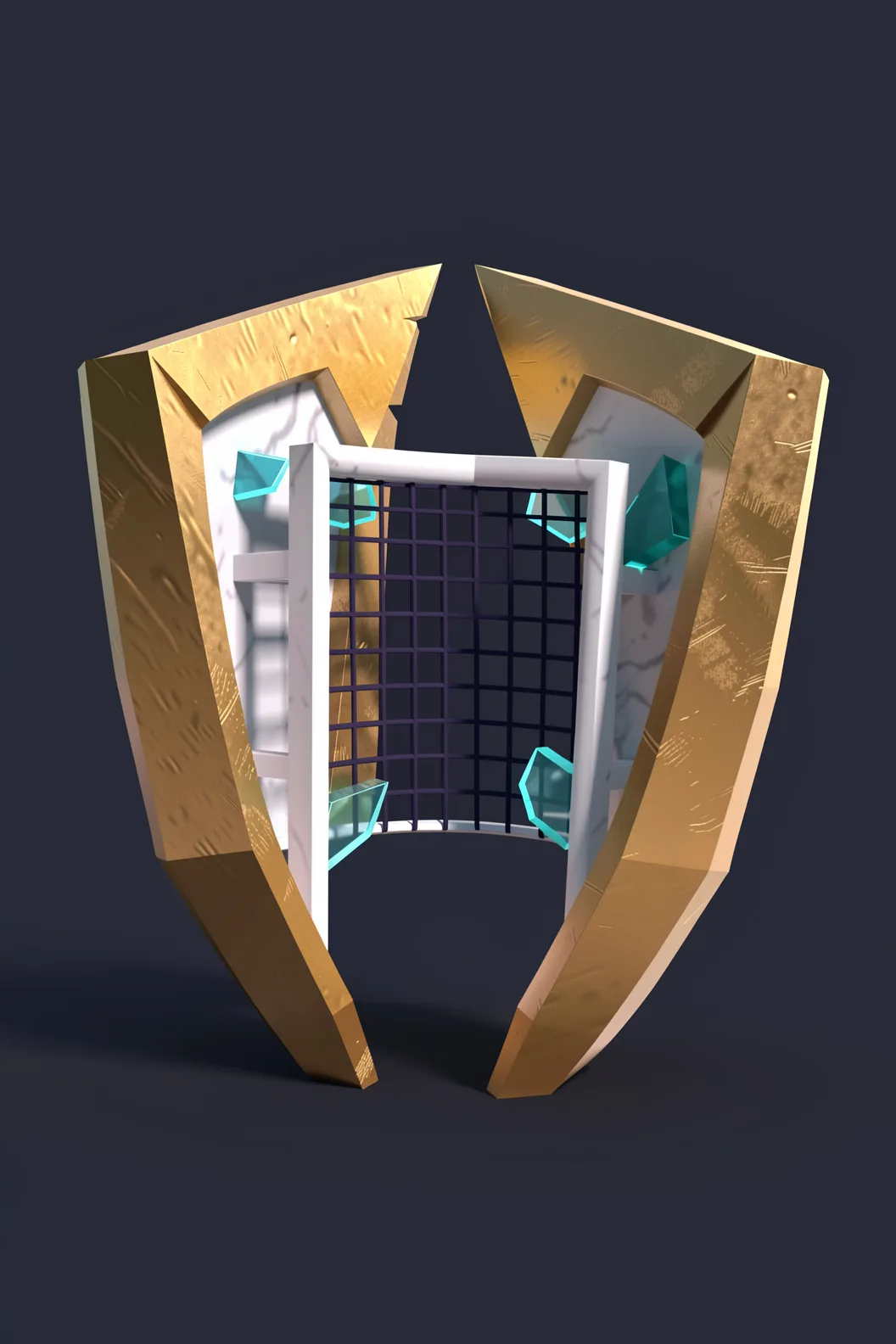
Anima does not retain the goal-plus-gate identity. FLUX describes useful components, but its shield and net relationship changes too much between seeds to be a canonical geometry blueprint.
Geometry-first scores
| Model | G1 | G2 | G3 | G4 | G5 | Decision |
|---|---|---|---|---|---|---|
| Qwen Image 2512 FP8 | 4 | 4–5 | 4–5 | 3 | 4 | Secondary reference |
| Z-Image Turbo BF16 | 5 | 5 | 4 | 3 | 5 | Best reference candidate |
| Anima Aesthetic v1.1 | 2 | 1–2 | 2 | 1 | 1 | Reject |
| FLUX.2 Klein 9B Q8 | 4 | 4 | 4 | 3 | 3 | Loose reference only |
Ranges capture the two fixed seeds. A score does not imply that the geometry is correct; it records how much reliable modelling information the image exposes.
The correct 2D-to-3D handoff
The chosen Z image should not be converted directly into a game mesh. The safe handoff is smaller and more reliable:
- Treat the image as a silhouette, material, and depth reference.
- Rebuild a simplified original shield, goal frame, net cage, and glass fragments in Blender from explicit primitive geometry.
- Save the canonical
.blend, create independent renders, then export a.glb. - Review that model before it enters the game; the image is not a texture import and does not prove collision, scale, UVs, or runtime performance.
This distinction matters most for a 2.5D pixel game. The game needs controlled low-poly geometry and nearest-neighbor final art, not accidental high-frequency detail from an image model.
Recommendation
Use Z-Image Turbo for quick single-prop modelling-reference exploration. Use Qwen as a secondary material study when the extra runtime is acceptable. Do not use Anima for this 2D-to-3D reference task. Keep FLUX.2 Klein as a loose alternative only when its output is manually checked against a geometry brief.
For final delivery, choose one reviewed reference, then make the model deterministically in Blender. The diffusion image starts the art conversation; it does not end the asset pipeline.